NGO Donations in Lucknow: 80G Tax Benefits Explained

A charitable donation can do more than provide immediate relief. It can help a child continue their education, give a patient access to medical assistance, or support families who cannot afford essential healthcare. However, when choosing where to contribute, donors also need to understand how their money will be used and whether the organisation meets the necessary legal requirements.
For individuals and businesses considering NGO donations in Lucknow, tax benefits can make charitable giving more financially rewarding. Under the familiar Section 80G framework, eligible monetary contributions to approved charitable organisations can qualify for deductions from taxable income.
Understanding the eligibility conditions, deduction limits, payment rules, and required documents can help you make informed decisions while supporting meaningful social work.
What Are the Tax Benefits of Donating to an NGO?
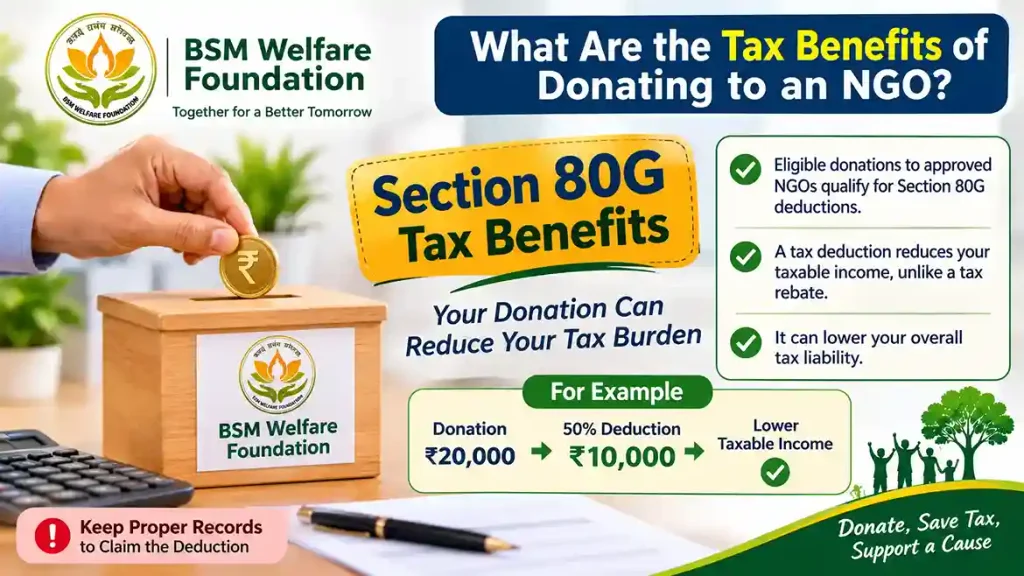
The Indian income tax framework provides deductions for eligible donations made to approved charitable institutions and specified relief funds. These benefits are commonly known as Section 80G tax benefits.
Unlike a tax rebate, which directly reduces the tax payable, a tax deduction reduces the income on which tax is calculated. This means that an eligible donation can lower your taxable income and potentially reduce your overall tax liability.
For example, if you donate ₹20,000 to an organisation eligible for a 50% deduction, you may claim ₹10,000 as a deduction, subject to the applicable conditions and limits.
However, not every charitable contribution qualifies for an NGO donation tax exemption. The receiving organisation must have the required approval, and the donor must maintain appropriate payment records and supporting documents.
Old Tax Regime vs. New Tax Regime
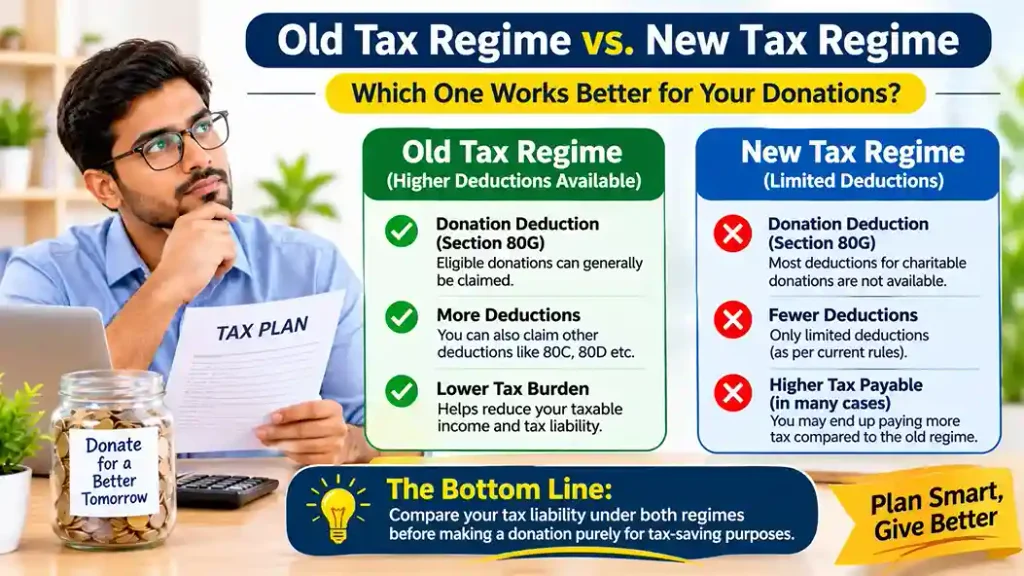
Your chosen tax regime also matters when planning charitable contributions.
- Old Tax Regime: Eligible donations can generally be claimed under the applicable Section 80G provisions.
- New Tax Regime: Most deductions for charitable donations are not available to individual taxpayers opting for the concessional tax structure.
Therefore, compare your tax liability under both regimes before making a donation purely for tax-saving purposes.
Which NGOs Are Eligible for Tax-Deductible Donations?
A charitable organisation does not automatically qualify to provide tax benefits simply because it works for social welfare.
To make eligible donations to registered NGOs, donors should check whether the organisation has the necessary legal registration and approval under the applicable income tax provisions.
Common legal structures include:
- Section 8 Company: A non-profit company registered under the Companies Act, 2013, which uses its income to promote charitable or other permitted objectives.
- Registered Public Trust: An organisation established to manage charitable activities and public welfare initiatives.
- Registered Society: An organisation formed to pursue educational, social, charitable, or other permitted objectives.
Along with its legal structure, the organisation must hold valid tax approval for eligible donations.
| Verification requirement | Why it matters |
| Legal registration | Establishes the organisation’s legal identity |
| Section 12A/12AB registration, where applicable | Relates to the organisation’s income tax exemption |
| Valid 80G approval under the applicable framework | Establishes eligibility to receive tax-deductible donations |
| PAN details | Helps identify the organisation and report contributions |
| Donation reporting compliance | Supports the generation of the donor’s prescribed certificate |
For example, BSM Welfare Foundation is presented as a Section 8 charitable organisation working in areas such as healthcare assistance and community welfare. Donors should independently verify its current registration and tax approval before claiming any deduction.
Understanding the 80G Deduction Limit: 50% vs. 100%
One of the most important things to understand before making a contribution is that all eligible donations do not receive the same deduction.
Under the familiar Section 80G classification, donations generally fall into two categories.
1. Donations Eligible for 100% Deduction
Certain specified government-established relief funds and national welfare funds qualify for a 100% deduction.
This means the entire eligible contribution can be deducted from taxable income, subject to the relevant provisions.
Examples under the earlier framework include:
- Prime Minister’s National Relief Fund.
- National Defence Fund.
- Other specifically notified government relief funds.
2. Donations Eligible for 50% Deduction
Many approved charitable organisations, including eligible NGOs, fall under the 50% deduction category.
These contributions are generally subject to a qualifying limit of 10% of the donor’s Adjusted Gross Total Income (AGTI).
This means that even if you donate ₹1 lakh, the entire amount may not qualify for a deduction. The applicable percentage and qualifying ceiling determine the actual benefit.
How Is the Deduction Calculated?
Consider a salaried professional with the following financial details:
| Particulars | Amount |
| Gross Total Income | ₹12,00,000 |
| Other eligible deductions | ₹2,00,000 |
| Adjusted Gross Total Income | ₹10,00,000 |
| 10% qualifying ceiling | ₹1,00,000 |
| Donation to an eligible NGO | ₹60,000 |
| Eligible deduction at 50% | ₹30,000 |
Since the donation falls within the qualifying ceiling, the donor can claim a deduction of ₹30,000 under this illustrative calculation.
The taxable income is consequently reduced by ₹30,000, potentially lowering the final tax liability.
Important: This example explains the earlier Section 80G calculation framework. For tax years beginning on or after 1 April 2026, donors must verify the corresponding provisions, qualifying limits, and filing requirements under the Income-tax Act, 2025.
What Documents Do You Need for an NGO Donation?
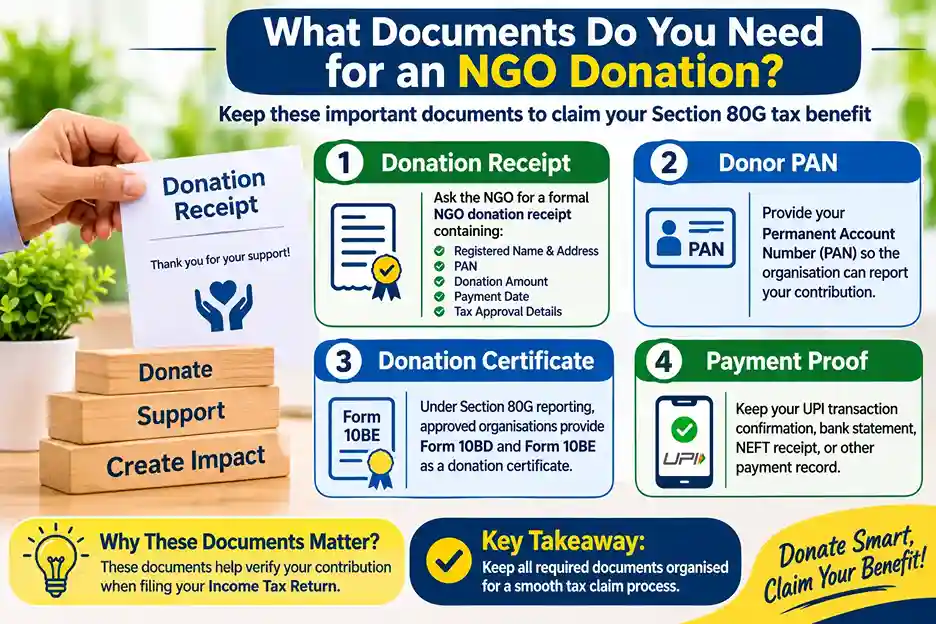
Proper documentation is essential when claiming a tax deduction. Making a bank transfer alone does not establish that a contribution qualifies for tax benefits.
When making an eligible donation, collect and preserve the following information:
1. Donation Receipt
Ask the NGO for a formal NGO donation receipt containing its registered name, address, PAN, donation amount, payment date, and relevant tax approval details.
2. Donor PAN
Provide your Permanent Account Number (PAN) so the organisation can correctly report the contribution against your details.
3. Donation Certificate
Under the earlier Section 80G reporting framework, approved organisations were required to submit donation details through Form 10BD and provide donors with Form 10BE.
These documents helped establish the donation record for income tax purposes. For the 2026 tax framework, check the currently prescribed reporting forms and certificates.
4. Payment Proof
Keep your UPI transaction confirmation, bank statement, NEFT receipt, or other payment record.
Having these documents organised makes it easier to verify your contribution when filing your income tax return.
Cash Donations vs. Digital Donations: What Should You Know?
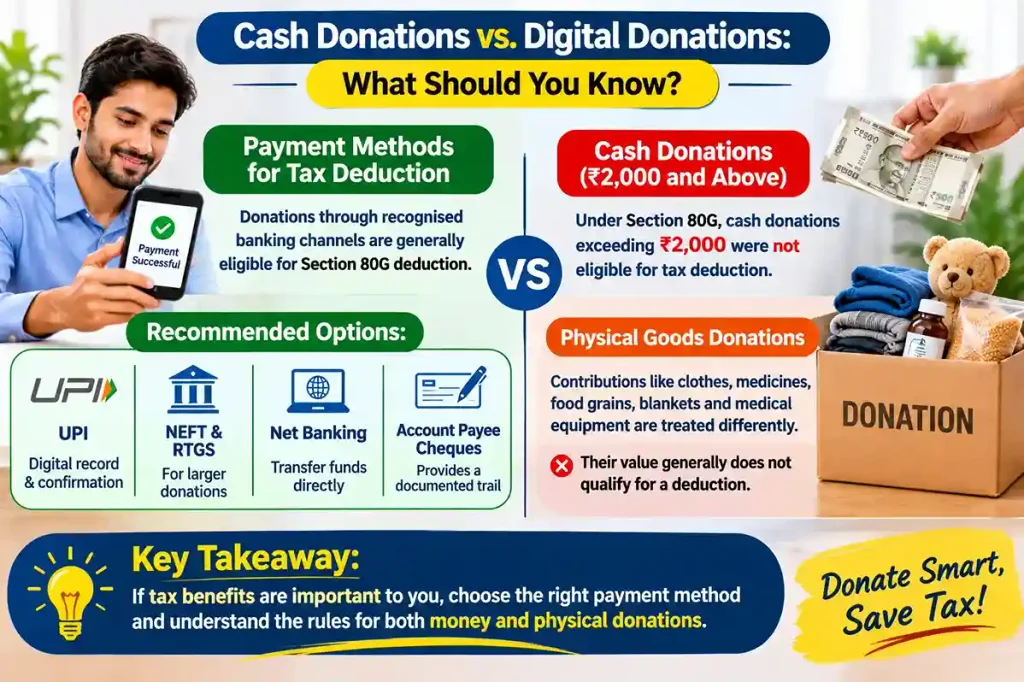
The payment method can affect whether your contribution qualifies for a tax deduction.
Under the earlier Section 80G framework, cash donations exceeding ₹2,000 were not eligible for deductions. Donations made through recognised banking channels were generally accepted, subject to other eligibility conditions.
Consider these payment options:
- UPI: Provides a digital transaction record and payment confirmation.
- NEFT and RTGS: Suitable for larger contributions with clear banking records.
- Net Banking: Allows donors to transfer funds directly to the organisation.
- Account Payee Cheques: Provide a documented payment trail.
There is another important distinction: donating money and donating physical goods are treated differently.
Contributions such as clothes, medicines, food grains, blankets, and medical equipment may support charitable activities, but their value generally does not qualify for a deduction under the earlier Section 80G framework.
If tax benefits are important to you, understand the applicable payment and eligibility conditions before contributing.
How to Verify an NGO in Lucknow Before Donating
Choosing the right charitable organisation requires more than checking its website or reading its mission statement. You should understand its legal standing, actual activities, and financial accountability.
Here are four practical checks to make before transferring money.
1. Verify Legal Registration and Tax Approval
Ask the organisation for its registration certificate, PAN, and applicable tax approval documents. Check whether the approval is valid for the relevant financial year or tax period.
2. Check NGO Darpan Registration
The NGO Darpan portal, maintained by NITI Aayog, provides information about registered voluntary organisations. You can use it to check available organisational details and its government registration records.
Remember that NGO Darpan registration alone does not establish eligibility for a tax deduction.
3. Understand Its Actual Social Activities
Look beyond the organisation’s stated objectives. Check whether it conducts healthcare initiatives, educational programmes, food distribution, patient assistance, or other activities.
For instance, BSM Welfare Foundation works in areas related to community healthcare and patient assistance. Its activities include patient-support initiatives and diagnostic health camps in Lucknow. Donors can enquire about its ongoing programmes and how contributions are allocated.
If you want to understand how community healthcare initiatives are organised, you can also read our guide on How to Host a Free Medical Camp. It explains important considerations involved in planning and conducting a medical camp.
4. Ask for Financial and Donation Records
A genuine organisation should be able to explain how it receives and utilises contributions. Ask for donation receipts, relevant financial information, and details about the programmes your contribution will support.
Transparency helps establish confidence that your money is reaching the intended cause.
How to Claim an NGO Donation Tax Deduction
Once you have made an eligible contribution, the next step is to report it correctly while filing your income tax return.
Under the earlier Section 80G framework, the process generally involved these steps:
- Check your tax regime: Confirm that you are using a tax regime that permits the relevant donation deduction.
- Collect donation details: Keep the organisation’s registered name, PAN, address, approval details, and donation amount.
- Obtain the prescribed certificate: Collect the applicable donation certificate from the organisation.
- Report the contribution: Enter the eligible amount in the relevant deduction schedule of your income tax return.
- Cross-check the information: Ensure that your declared contribution matches the organisation’s reported donation details and available tax records.
For tax years governed by the Income-tax Act, 2025, use the updated ITR schedules and prescribed forms rather than relying on older filing instructions.
If you are unsure about eligibility or the calculation, consult a qualified tax professional before submitting your return.
Frequently Asked Questions
1. Can I get a tax deduction for donating to any NGO?
No. The organisation must satisfy the applicable registration and tax approval requirements. A charitable purpose alone does not make every contribution eligible for a deduction.
2. Can I claim a deduction for donating through UPI?
Yes, digital payments such as UPI, NEFT, RTGS, and net banking can provide valid transaction records. However, the recipient’s eligibility and other applicable tax conditions must also be satisfied.
3. Is a Section 8 company eligible to receive tax-deductible donations?
A Section 8 company can qualify if it has the necessary approval under the applicable income tax provisions. Its incorporation as a non-profit company does not automatically establish donation eligibility.
4. Can I claim a deduction for donating medicines or clothes?
Generally, no. Under the earlier Section 80G framework, deductions applied to eligible monetary contributions rather than donations of physical goods.
5. What is Form 10BE?
Form 10BE was the certificate issued to donors under the earlier Section 80G reporting framework after the organisation reported donations through Form 10BD. Donors should check the prescribed certificate applicable to their tax year.
Conclusion
Charitable giving becomes more meaningful when donors understand both the social impact and the financial implications of their contributions. Before making NGO donations in Lucknow, check the organisation’s legal credentials, ongoing welfare activities, and eligibility for tax benefits. BSM Welfare Foundation works towards supporting community healthcare and other social welfare initiatives. If you are considering contributing, explore its work, verify its current tax approvals, and make an informed donation that supports a cause worth pursuing.